
Jul 20, 2026
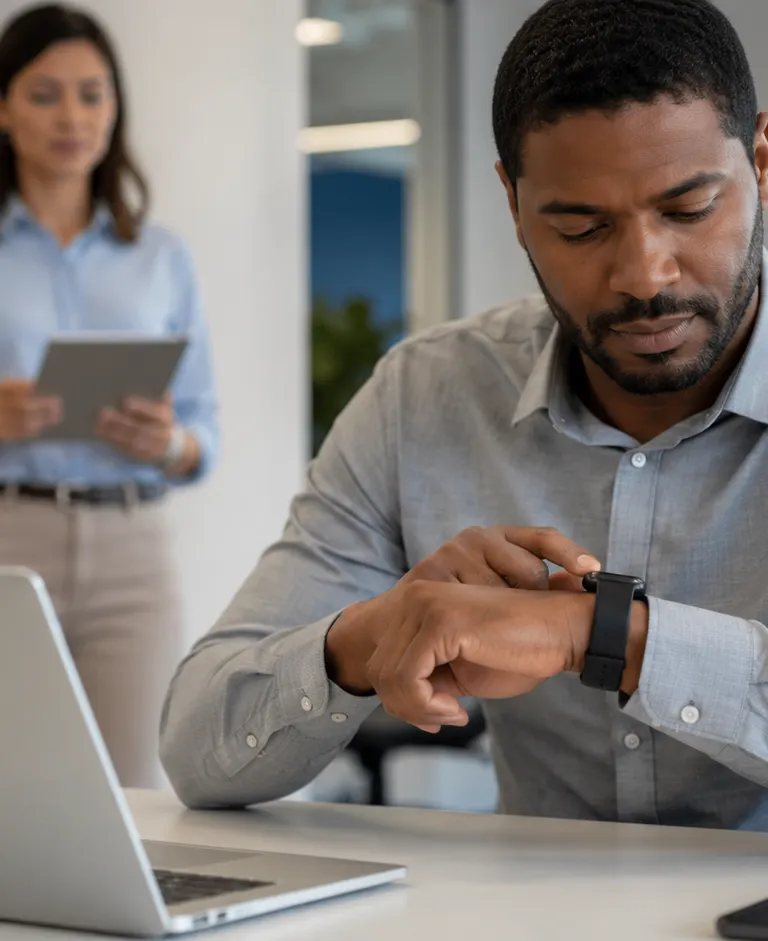


Wearable technology is changing how some New Jersey employers monitor workplace activity and run wellness programs. When employers use wearable data to track employees beyond legitimate workplace purposes, the information collected can become a privacy issue rather than a wellness tool.
Employers must understand the difference between workplace monitoring and information that remains private to the employee. While reviewing these policies, our legal team at Brandon J. Broderick examines what data a device collects, who has access to it, and how that information may affect employment decisions. Employees who participate in wellness programs or productivity initiatives may not always realize the full scope of the information being gathered, but the use of a fitness tracker does not eliminate protections for personal information, medical details, or workplace privacy.
In this guide, we talk about how state and federal law apply to fitness trackers and wearable technology in the workplace, what employers can monitor, where privacy limits exist, and when employees may need help from an employment lawyer in New Jersey.
Employers use wristbands, smart badges, headsets, and posture sensors to supervise work, reduce injuries, and measure output. Some tools stop after a shift, while others sync with a phone or cloud account and continue gathering information. Workplace devices collect:
Safety supports some monitoring. The National Institute for Occupational Safety and Health describes wearables that warn workers about approaching equipment, measure heat strain, or detect hazardous exposures.
A 2024 Government Accountability Office assessment found limited evidence showing that ergonomic sensors reduce injuries. Employers still must address unsafe staffing and working conditions.
New Jersey has no general statute devoted to employee wearables. Its Data Privacy Law, effective in 2025, doesn’t apply to workers. According to the state’s Division of Consumer Affairs, a person whose information is collected in an employment context isn’t a covered “consumer.” Its access, deletion,n and opt-out rights don’t govern ordinary employee records.
New Jersey law requires written notice before an employer knowingly uses a tracking device in a vehicle used by an employee. N.J.S.A. 34:6B-22 doesn’t demand the same requirement on a wristband or badge.
The absence of a specific rule doesn’t give employers unlimited access to employee data. Privacy protections still apply when monitoring becomes highly intrusive. Tracking a company device during work hours is different from collecting information such as sleep habits, conversations outside work, location at home, or brainwave activity.
An employer policy can limit privacy expectations for certain work activities, but it does not allow unlawful monitoring or discrimination. Our attorneys at Brandon J. Broderick build these claims by examining the policy, the technology involved, and the employer’s use of the information collected. Public employees may have additional rights under the Constitution when facing government searches.
“The decision to speak up is powerful. But knowing what happens after — and how to protect yourself — is just as critical.”
— Olivia Rhye
Heart rate, blood pressure, sleep, stress, and temperature readings disclose far more than productivity. Once a device seeks information about a worker’s physical or mental condition, the Americans with Disabilities Act enters the analysis. The Equal Employment Opportunity Commission’s guidance defines a medical examination as a procedure or test that seeks information about physical or mental health.
An ADA-covered employer must show that a medical examination is connected to the job and consistent with business necessity. The standard may apply when an employer seeks medical information related to a short-term disability claim, but the request still must be tied to legitimate workplace needs. Business necessity requires objective evidence connecting the condition to an essential job function or a direct threat. An interest in healthier employees or higher productivity doesn’t qualify.
Any employer program must follow privacy laws when collecting sensitive information. For example:
The ADA permits voluntary employee health programs to request medical information. “Voluntary” loses meaning when participation is required, discipline is threatened, or a financial consequence leaves little choice.
An old EEOC rule approved incentives worth up to 30% of employee-only health coverage. A federal court vacated it, and the EEOC removed it from the regulations on Jan. 1, 2019. The former 30% figure is not a current ADA safe harbor.
GINA limits what employers can do with genetic information, including family medical history. Employers cannot request, use, or share this information unless a specific exception applies. A wellness program that collects genetic information must obtain the employee’s written authorization.
HIPAA is narrower than many employees assume. When the program forms part of an employer-sponsored group health plan, information held by the plan receives HIPAA protection. The plan cannot freely give individual health data to management for any employment decisions. HHS workplace wellness guidance explains the distinction.
Employers often see only a final score or report, while device companies, wellness platforms, and cloud providers may hold the original data.
With 42% of employees reporting that they feel micromanaged at work, additional monitoring tools can create concerns about how closely employers track daily activity. Many workers who reach out to our legal team have questions about who can access that information and how it may be used. The answer depends on app permissions and privacy notices that explain where the data goes and how long it is kept.

New Jersey’s Law Against Discrimination prohibits employers from making decisions because of disability, perceived disability, pregnancy, sex, age, genetic information, and other protected characteristics. Unlike the main federal discrimination statutes, the NJLAD does not require an employer to have at least 15 employees. It also applies when a third-party vendor supplies the score or recommendation. An employer remains responsible for a discriminatory result produced by a tool it chose to use.
New Jersey’s Division on Civil Rights made this point in its 2025 guidance on algorithmic discrimination. Automated tools receive no NJLAD exception. Liability follows when a tool causes intentional bias, creates an unjustified disparate impact, or blocks a reasonable accommodation.
Wearable data can create misleading conclusions. For example:
Accommodation rules apply to the device itself. A worker may need a different band because of a skin condition, cannot use certain sensors because of a medical implant, or object to more invasive technology, such as mandatory RFID implants.
Pregnancy, disability, and sincerely held religious practices may require employers to consider another monitoring method instead of disciplining the worker. The ADA, PWFA, Title VII, and NJLAD all require a case-by-case review.
GAO’s 2025 worker-surveillance report reviewed 122 studies and interviewed researchers, employers, and workers. It found positive and negative effects on physical safety and mental health. Flawed benchmarks, incomplete measures of job duties, and use beyond a tool’s original purpose also exposed workers to poor evaluations, lower pay, discipline, and termination. Those findings support human review before action on a score.
Location monitoring becomes harder to justify after a shift. An employer has a stronger interest in a delivery worker’s location during a route than later that evening. Continuous collection also captures visits to doctors, religious services, union meetings, and private homes. Workplace wearable privacy depends on both the data and the collection period.
Intentionally intercepting an oral, wire, or electronic communication without consent from any participant violates N.J.S.A. 2A:156A-3.
Some records also affect pay claims. Data showing work during an unpaid meal period or after clocking out sometimes contradicts official records. The Fair Labor Standards Act requires payment for work the employer knew or had reason to know was performed. A U.S. Department of Labor bulletin confirms that an unauthorized-work rule doesn’t erase earned wages.
Our specialists often recommend that workers keep copies of any documents related to a dispute. This includes:
Legislation introduced in 2026 would create broader rules, but it is not law. Assembly Bill A4981 would regulate AI-based tools collecting sensitive data. Current disputes still depend on existing privacy, discrimination, wage, wiretap, and labor laws.
If you have questions about an employer’s use of wearable technology or workplace monitoring, contact us today for a free consultation.
 Svetlana Skvortsova
Stop wondering about your rights or if you'll be taken seriously. We treat every client with respect, urgency, and honesty. Our lawyers will listen, explain your legal options, and fight for the outcome you deserve.