
Jun 30, 2026Whistleblower Retaliation
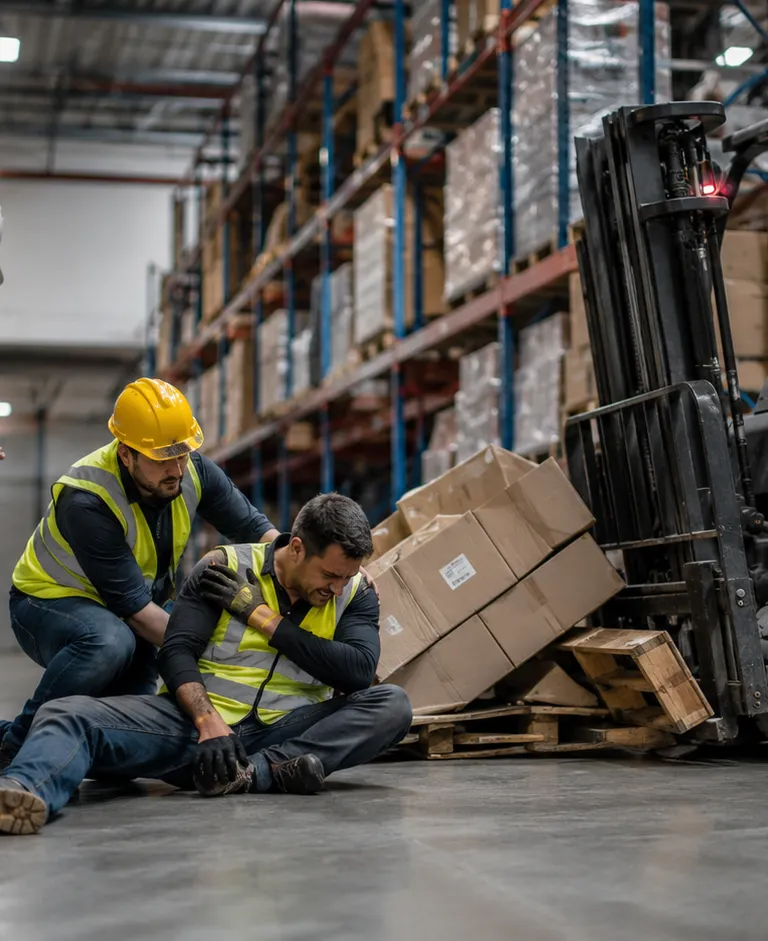


Forklifts are a common part of daily operations in many New Jersey workplaces. They are also involved in some of the most serious workplace accidents, including life-changing injuries and fatal incidents when safety procedures are ignored or operating conditions become unsafe.
Forklift accidents often create both workers' compensation claims and potential claims against third parties whose actions contributed to the injury.
Most accidents involve more than a simple workplace mishap. In many injury cases reviewed by our team at Brandon J. Broderick, a collision, tip-over, falling load, or pedestrian strike leads to questions about equipment maintenance or unsafe workplace conditions. Understanding who played a role in the incident is critical because the available legal remedies depend on how the accident occurred.
This guide explains how responsibility is evaluated after a workplace accident, when a third party may be liable for a worker's injuries, what compensation may be available, and when to consult an employment lawyer in New Jersey.
Forklifts are among the most dangerous pieces of equipment in any warehouse. According to the National Safety Council, forklifts were the source of 84 work-related deaths in 2024. From 2023 to 2024, more than 25,000 nonfatal injuries were recorded.
Warehouse workers experience injuries at a rate of 4.8 cases per 100 workers, which is more than double the average across all industries.
Serious accidents can occur during routine warehouse operations. While the facts differ from case to case, many incidents involve vehicle movement, elevated work, shifting loads, or contact between forklifts and workers in the surrounding area. These risks are more pronounced in warehouses with strict productivity quotas that leave little room for delays or interruptions.
Common accidents include:
The causes behind these accidents tend to repeat. Inadequate operator training or poor visibility can create conditions that lead to serious incidents. Mechanical failures may also contribute when equipment isn’t properly maintained or safety systems malfunction.
OSHA regulates forklift operation under 29 C.F.R. 1910.178. The standard requires operator training and certification, daily equipment inspections, and the removal of defective forklifts from service until repairs are completed. OSHA recorded 2,150 violations of its Powered Industrial Trucks standard in 2025, making it the agency's eighth most frequently cited safety standard nationwide. The standard covers all powered industrial vehicles used in the workplace.
New Jersey is home to one of the country's busiest logistics and distribution networks. Warehouses located near Port Newark-Elizabeth, the Meadowlands, and major interstate corridors depend heavily on forklifts as part of their daily operations.
“The decision to speak up is powerful. But knowing what happens after — and how to protect yourself — is just as critical.”
— Olivia Rhye
For most injured workers, New Jersey's Workers' Compensation Act is the primary option for obtaining benefits. The law provides benefits on a no-fault basis. The worker doesn’t have to prove fault or negligence on the part of the employer.
The trade-off comes from N.J.S.A. 34:15-8, the exclusive remedy provision. In exchange for guaranteed no-fault benefits, a worker gives up the right to sue the employer for negligence. An employer that failed to train operators properly or ignored a known hazard still can't be sued directly.
Workers' compensation provides several benefits after a forklift injury. Depending on the circumstances, it may include medical treatment, temporary disability benefits during periods of lost work, and permanent disability benefits when an injury results in lasting limitations. In fatal cases, the law also provides benefits for qualifying family members. Determining eligibility can become complicated when worker classification is disputed, an issue that frequently arises in some areas of the construction industry.
Workers receiving temporary disability benefits are entitled to 70% of their average weekly wage, up to the maximum amount permitted by law. The 2026 maximum weekly benefit is $1,199. This affects construction workers and others performing public works projects at prevailing wage rates, where earnings can exceed the statutory maximum.
Workers' compensation isn’t designed to compensate for every consequence of a workplace injury. The system doesn’t award damages for pain and suffering, emotional distress, loss of career opportunities, or similar non-economic losses. Wage replacement and disability benefits are also subject to statutory limits and strict formulas.
There is a limited exception to New Jersey's exclusive-remedy rule. Under Laidlow v. Hariton Machinery Co., an employee may sue an employer directly only by proving an “intentional wrong”. That means showing the employer was aware of the danger and was “substantially certain” to cause injury, yet workers were still exposed to it. In our experience, that is a demanding standard and one that does not apply to most negligence claims.

The exclusive-remedy rule prevents lawsuits against the employer, but it does not prevent claims against other parties who contributed to the injury. Under N.J.S.A. 34:15-40, an injured worker may pursue a separate civil claim against a negligent third party while also receiving workers' compensation benefits.
A "third party" is any person or company other than the worker's direct employer. This may include:
One potential source of compensation after a forklift accident is New Jersey's Products Liability Act. When defective equipment or a component contributes to a worker's injuries, a claim may be pursued against the manufacturer. The condition of the product is central to these claims. The injured worker must show that a defect existed when the product left the manufacturer's control and that the defect played a role in causing the injuries.
A third-party claim may provide compensation for full lost wages, pain and suffering, emotional distress, loss of enjoyment of life, and loss of consortium for a spouse. Our team at Brandon J. Broderick regularly works with seriously injured workers whose losses are not fully addressed by workers' compensation benefits alone.
A third-party claim is handled differently from a traditional workers' compensation claim. The worker must establish a product defect or another legal basis for liability. Most New Jersey personal injury and product liability claims must be filed within two years of the accident under N.J.S.A. 2A:14-2.
Recovering through both workers' compensation and a third-party lawsuit doesn’t result in the worker keeping the full amount. New Jersey law prevents a double recovery through the workers' comp lien under the Section 40 lien.
The insurance carrier that paid the worker's medical bills and wage benefits has the right to be reimbursed out of the third-party recovery. If a worker receives compensation from a manufacturer, part of that recovery is used to repay benefits previously paid by the carrier. That reimbursement right is often separate from the employer itself. It may continue even after the employer's bankruptcy.
The amount that must be repaid isn’t always equal to the full amount of the benefits. The workers' compensation carrier must share in the cost of obtaining the recovery. This includes up to $750 in costs and one-third of the attorney's fee, which reduces the amount the carrier gets back.
Even with a Section 40 lien, pursuing both claims results in greater overall compensation. The lien applies to workers' compensation benefits like medical care and wage benefits. Pain-and-suffering damages are separate and can account for a substantial share of the recovery in a third-party case. Serious accidents can also lead to compensable mental injuries, which may add another layer to the overall claim.
A third-party recovery can also affect future workers' compensation benefits. If the worker receives more than the lien amount, the carrier may get a credit that lowers some future payments. The benefits aren’t eliminated, but the carrier may suspend payments until that credit has been used up.
The workers' compensation claim and the third-party claim are separate proceedings, but the outcome of one can affect the other. Liens and reimbursement rights in one case can affect the other. In addition, a workers' compensation carrier may have subrogation rights that allow it to pursue recovery from a responsible third party.
In many injury cases we build, the accident involves more than the employer and the workers' compensation system. A manufacturer, contractor, maintenance provider, or another third party may have contributed to the conditions that led to the injury. In those situations, workers' compensation may not be the only available source of compensation.
If you suffered injuries in a New Jersey warehouse accident, we can help you understand the legal options available. Contact us today for a free consultation.
 Svetlana Skvortsova
Stop wondering about your rights or if you'll be taken seriously. We treat every client with respect, urgency, and honesty. Our lawyers will listen, explain your legal options, and fight for the outcome you deserve.