
Jun 30, 2026Whistleblower Retaliation
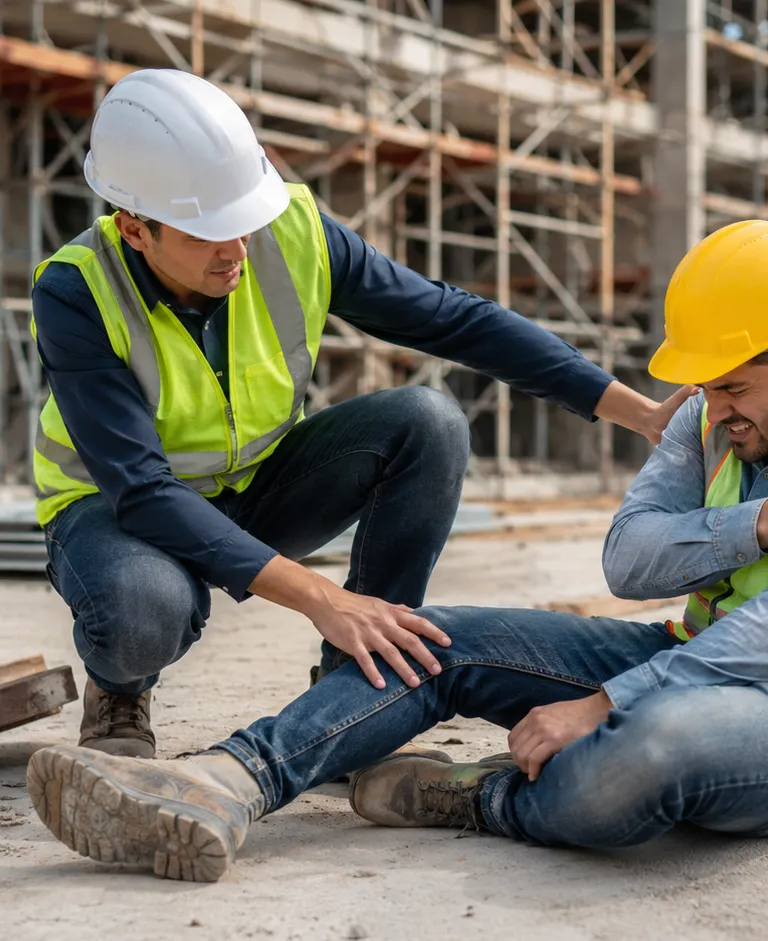


Most construction projects bring together a variety of companies working in the same area. General contractors, subcontractors, suppliers, and equipment operators may all be involved in different aspects of the job.
A worker's employer is not always the party most responsible for a construction accident. Our attorneys at Brandon J. Broderick regularly review construction accident cases involving falling materials, equipment collisions, scaffold failures, trench hazards, and other site-safety issues. Many of these incidents are connected to the work of subcontractors or other companies operating on the same project.
Workers' compensation benefits are one part of the claim in those situations. Identifying who created the hazard is also important. An injury caused by a subcontractor creates legal claims that extend beyond the benefits available through workers' compensation.
In this guide, we cover the role of third-party liability in construction accident cases, how workers' compensation and third-party claims interact, the compensation that may be available, and when to reach out to an employment lawyer in New Jersey.
New Jersey workers' compensation is a no-fault system. An injured worker collects benefits regardless of who caused the accident and gives up the right to sue the employer for most workplace injuries. The trade-off comes from the exclusive remedy rule at N.J.S.A. 34:15-8.
Comp covers the medical treatment. Payment for temporary disability at 70% of wages up to a state maximum of $1,199 per week in 2026. Permanent disability payment applies for lasting harm. Death benefits can be paid to surviving family members.
The system is still limited. It doesn’t provide compensation for pain and suffering. In some cases, injured workers also face separate issues related to denied leave requests or taking time off for treatment and recovery.
Wage benefits replace only a portion of a worker's income. The weekly cap can leave higher earners recovering far less than they previously earned. The difference is greater for workers who regularly relied on overtime or split-shift premiums as part of their overall income.
Permanent disability benefits provide important compensation, but they do not always reflect the full impact a serious injury can have on a worker's future earning capacity. That is particularly true for younger workers who may face decades of reduced earnings. The calculation doesn’t fully reflect how the injury affects future job opportunities, even when disability accommodations are available.
This protection applies only to the worker's employer and co-workers acting within the scope of their employment. It doesn’t extend to other companies working on the same job site. When a worker is injured because of another company's negligence, they have a workers' compensation claim through the employer and a separate case against the company.
These situations are common in the construction industry. A single New Jersey job site brings together a general contractor, several subcontractors, equipment rental firms, and material suppliers, all working on the ground at the same time.
The source of a workplace injury is not always tied to the worker's employer. A subcontractor may create a hazard that leads to an accident, giving rise to a separate claim. In some situations, liability issues also involve allegations that a company retained a dangerous worker with a known record of unsafe conduct. Determining who contributed to the injury often shapes the entire case.
Federal data reflects common construction safety issues. OSHA issued 6,992 fall-protection citations in 2025, making fall protection the agency's most frequently cited standard that year. For the most serious violations, penalties can reach $165,514 per violation.
“The decision to speak up is powerful. But knowing what happens after — and how to protect yourself — is just as critical.”
— Olivia Rhye
A third party is any person or company, other than the worker's employer or a co-worker, whose negligence contributed to the injury.
Claims against third parties are brought in New Jersey Superior Court. They allow injured workers to pursue damages that aren’t available otherwise. For example, coverage for pain and suffering and full wage losses.
The common third parties on a New Jersey job site include:
General contractors hold a particular exposure. Most retain responsibility for site-wide safety through their contracts and their control over the work. OSHA's multi-employer policy holds the controlling employer responsible for a hazard it had the authority to correct. An OSHA finding supports a civil negligence claim against the general contractor.
New Jersey's Product Liability Act holds a manufacturer responsible for a defective product regardless of negligence. A collapsed scaffold or a saw sold without an adequate guard supports a product liability claim. In those cases, the focus is on the condition of the product itself rather than the actions of a particular worker or company.
A worker generally cannot sue a co-worker because workers' compensation provides the exclusive remedy. Our legal team at Brandon J. Broderick regularly sees construction accidents where the workers involved were employed by different subcontractors. Identifying every third party early separates a comp-only outcome from a full recovery.

A worker does not have to choose between workers' compensation and a third-party lawsuit. New Jersey law allows both to proceed at the same time, even though they are handled in different forums. One claim moves through the Division of Workers' Compensation, while the lawsuit is filed in Superior Court.
Each serves a different purpose. Workers' compensation helps cover medical care and a portion of lost income while the worker recovers. A third-party claim focuses on additional damages and losses tied to the injury.
When the worker wins or settles the third-party case, the comp insurer is entitled to be repaid for the benefits it already provided. This repayment is a Section 40 lien, named for N.J.S.A. 34:15-40.
New Jersey law sets out specific rules for calculating the amount. Like a wage lien, it is governed by statute and follows its own reimbursement formula. The carrier doesn’t recover every dollar it paid because it must share in the cost of obtaining the recovery.
Part of the attorney's fee, up to one-third, is applied as a reduction to the lien. The same is true for certain litigation expenses, up to $750. In many cases, the worker keeps more of the recovery than the original amount might suggest.
A simple example shows how it works. If the comp pays $150,000 in benefits and the worker settles the third-party case for $500,000, the carrier doesn’t take back the full $150,000. After the one-third reduction for the attorney's fee and the $750 cost deduction, the carrier may recover $99,500. The rest of the settlement goes to the worker.
Even when part of the recovery is used to satisfy the lien, the worker may still receive more than workers' compensation provides on its own. This additional recovery can include pain and suffering or emotional distress. Obtaining it depends on showing that the third party contributed to the injury.
A third-party claim is fault-based. The worker has to show that the third party owed a duty of care and failed to meet it. An accident alone isn’t enough; the case rests on negligence or a defective product.
Gathering evidence early is important. When our attorneys investigate these cases, OSHA inspection files are often a key source of information. They help establish who controlled the work area and the hazard involved. Photographs and videos of the site and equipment also provide important details that may not appear anywhere else.
Contracts show which company controlled the site or the task. Statements from coworkers and other crews who saw the accident can fill in what the documents leave out. In a product-failure case, the equipment itself, preserved rather than returned or repaired, becomes the central piece of proof. Medical records connect the injury to the incident.
Being partly responsible for an accident doesn’t automatically prevent a worker from recovering compensation. Under New Jersey law, compensation may still be available as long as the worker is not more than 50% responsible for the injury. Any recovery is reduced by the worker's share of fault.
New Jersey's statute of limitations for a personal-injury third-party claim is two years from the date of injury, under N.J.S.A. 2A:14-2. Missing that filing deadline can prevent the case from moving forward, even when the underlying facts are strong. It’s important to evaluate both possibilities early.
Acting promptly is important. Construction sites change constantly. Equipment may be repaired, returned to a rental company, replaced, or removed from the site. Workers sometimes move on to other projects once their portion of the job is complete. It becomes more difficult to preserve the evidence.
Contact us for a free consultation today if you have questions about a construction site injury or the steps that should be taken to protect a potential claim.
 Svetlana Skvortsova
Stop wondering about your rights or if you'll be taken seriously. We treat every client with respect, urgency, and honesty. Our lawyers will listen, explain your legal options, and fight for the outcome you deserve.