
Jun 30, 2026Whistleblower Retaliation
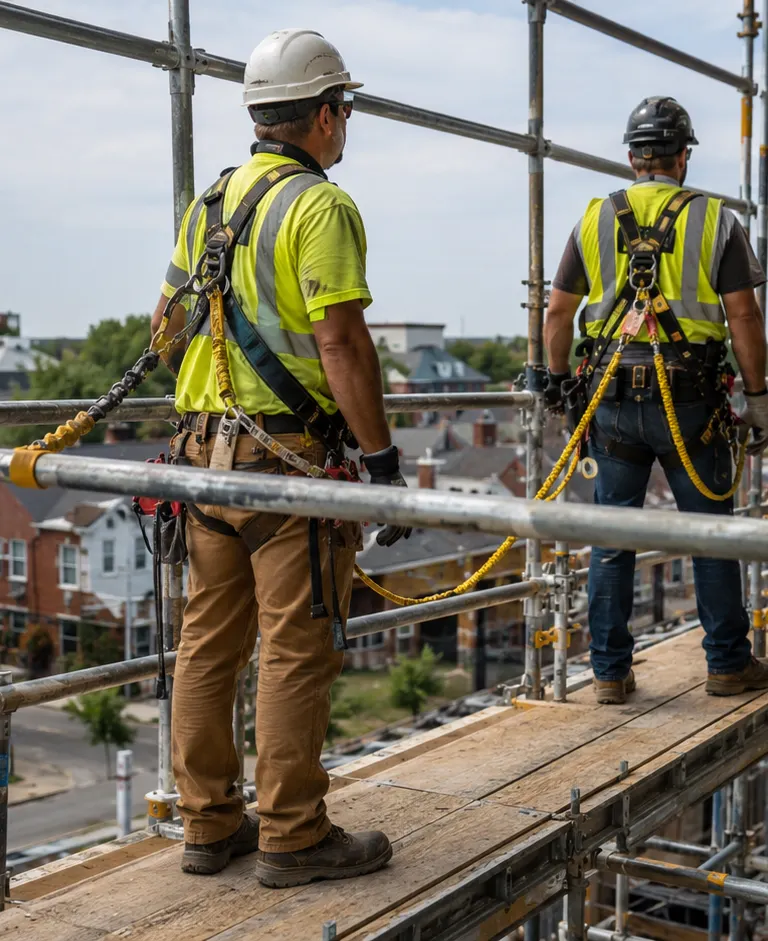

Falls continue to be one of the leading causes of serious injuries and fatalities on construction sites throughout New Jersey. Much of the work takes place at elevated heights, making protection systems and scaffold safety requirements essential safeguards. When those protections are missing or inadequate, the consequences can be severe.
When fall protection measures are inadequate, or scaffold safety rules are ignored, workers face a significantly greater risk of serious injury.
Construction falls frequently involve more than a momentary lapse or isolated error. Our attorneys at Brandon J. Broderick regularly review cases involving falls from scaffolds, roofs, ladders, platforms, and other elevated work areas. Many of these incidents involve missing safety measures, unsafe conditions, inadequate training, or failures to follow required procedures.
In this guide, we explain what obligations employers and contractors must satisfy, how the injuries are investigated, what compensation is available after an accident, and when to reach out to an employment lawyer in New Jersey.
OSHA requires fall protection for any construction worker on a surface with an unprotected edge 6 feet or more above a lower level. The requirement appears at 29 C.F.R. 1926.501, and the 6-foot mark governs most of a job site.
The employer decides how to meet it but has to provide one of three options: guardrails along the edge, safety nets below, or a personal fall arrest system. This includes a harness, lanyard, and a solid anchor point. The equipment requirements appear at 1926.502, and the duty to train workers on it appears at 1926.503. Those protections are considered part of the job's safety requirements, and the employers cannot treat them as a personal expense or recover their cost through wage deductions.
Some hazards require protection at any height. Work over dangerous equipment demands fall protection regardless of the drop. Skylights and floor openings need covers or guardrails.
Scaffolds fall under a separate rule. OSHA requires fall protection for scaffold work at heights of 10 feet or more under 29 C.F.R. § 1926.451. The standard goes beyond fall protection and also regulates:
A competent person, someone trained to spot the defects that cause collapses, has to erect and check the scaffold. Other trades carry their own thresholds, including steel erection at 15 feet.
The duty is on the employer, not the worker. The employer provides the protection, maintains it, trains the crew to use it, and confirms the surface holds weight before anyone steps onto it.
OSHA enforces these rules. Fall protection has ranked as the agency's most-cited violation, with 6,992 citations in 2025. The maximum penalty for a single willful violation now reaches $165,514. A fall from an unguarded edge or a poorly built scaffold almost always means the employer ignored a known requirement.
“The decision to speak up is powerful. But knowing what happens after — and how to protect yourself — is just as critical.”
— Olivia Rhye
Rigging guardrails and building a scaffold to specification takes time, and construction schedules tend to reward speed. Some failures repeat across job sites. The common ones include:
Workers can suffer traumatic brain injuries, spinal cord damage, paralysis, multiple fractures, internal bleeding, and death. Even a relatively short fall onto concrete, steel, equipment, or other hard surfaces can have devastating consequences. Many of the construction workers who contact our attorneys at Brandon J. Broderick after a fall are facing injuries that affect their ability to work and earn a living.
Scaffold failures affect multiple workers at once. A problem with a platform or support component may affect everyone using the scaffold. When that happens, attention frequently turns to the companies responsible for the scaffold's design, rental, assembly, or maintenance, rather than solely to the worker's employer.
Most New Jersey construction sites are shared workplaces where several companies operate at the same time. The injured worker may be employed by one company, while other contractors and equipment providers are also involved in the project. This can be particularly important for probationary employees, who have less experience on the site and rely heavily on proper supervision.
OSHA's multi-employer policy reflects that reality by recognizing that responsibility for a hazard may extend beyond a worker's direct employer. A fall is often linked to conditions that multiple companies had the ability to identify or correct, which can shape the entire case.

New Jersey workers' compensation is a no-fault system. An injured worker collects benefits regardless of who caused the fall and gives up the right to sue the employer for most injuries. This exclusive remedy rule comes from N.J.S.A. 34:15-8.
Comp pays for all medical treatment. It also covers temporary disability benefits while the worker is out, set at 70% of wages up to a state maximum of $1,199 per week in 2026. Permanent disability benefits may be available when a worker suffers lasting harm, such as paralysis, a traumatic brain injury, or the loss of use of a limb. Serious accidents can lead to psychological trauma, including PTSD or anxiety that may be compensable.
When a fall is fatal, the workers' compensation system also provides death benefits for qualifying family members.
Benefits are available for medical treatment and lost wages, but they do not include compensation for pain and suffering. Workers living with paralysis, traumatic brain injuries, or other life-altering conditions may face long-term financial and personal consequences that exceed the benefits available under the statutory formula.
Classification disputes can complicate these claims. Independent-contractor arrangements and cash payments are common in parts of the construction industry. Under New Jersey's classification test, the focus is on the reality of the working relationship. A 1099 label doesn’t prevent a worker from qualifying for the benefits.
For example, construction supervisors are sometimes labeled as contractors despite the level of control exercised over their work.
Workers' compensation remains a reliable source of benefits for injured construction workers, particularly when immediate medical treatment and wage replacement are needed. Our attorneys often find that serious falls are connected to multiple companies, creating additional avenues for recovery beyond the workers' compensation claim.
Employers who carry no comp insurance face separate penalties, and an injured worker still has ways to recover.
An injured worker is allowed to sue a non-employer whose negligence caused the fall, while still collecting comp from the employer. These claims allow full damages, including pain and suffering and the full amount of lost earnings.
The investigation focuses on more than one company. For example:
Signs a third-party claim exists include:
When a third-party claim is successful, the insurer has a right to recover certain benefits it has already paid. That repayment affects the worker's net recovery, but it doesn’t eliminate the value of pursuing both claims.
Workers' compensation is usually the exclusive remedy against an employer. New Jersey recognizes a narrow exception when the evidence shows the injury resulted from an intentional wrong.
The New Jersey Supreme Court discussed this standard in Millison v. E.I. du Pont de Nemours & Co. (1985). It later applied the same substantial-certainty analysis in Laidlow v. Hariton Machinery Co. (2002).
Courts look at whether the employer knew serious injury was “substantially certain” to occur. In some of these cases, known safety hazards remained uncorrected, or required fall protection wasn’t provided. The standard is a demanding one. Many cases focus on third-party liability rather than the intentional-wrong exception.
The OSHA investigation that follows a serious fall becomes an important source of information. Inspection reports and related records can help identify which company was responsible for the hazardous condition.
Workers' compensation is only one part of the picture, and a careful review of all potentially responsible parties can have a significant impact on the overall recovery.
If you were injured, contact us to discuss the accident and the evidence that may help identify all available claims.
 Svetlana Skvortsova
Stop wondering about your rights or if you'll be taken seriously. We treat every client with respect, urgency, and honesty. Our lawyers will listen, explain your legal options, and fight for the outcome you deserve.