
Jul 14, 2026Family and Medical Leave Act Interference


New Jersey has a reputation for diners, shore traffic, and never pumping your own gas. It also has a thick rulebook. Some of those rules sound unusual — even “weird.” But when you look closer, most have practical safety, consumer-protection, or public-order roots.
Below are 15 oddball New Jersey laws that actually exist, what they mean for day-to-day life, and why the rules are on the books.
New Jersey remains one of the few states in the nation where drivers are not allowed to pump their own gas. That’s because the Retail Gasoline Dispensing Safety Act prohibits self-service gasoline, requiring that attendants handle all fueling. The law was originally passed to promote safety and protect consumers — and it still carries penalties for anyone who ignores it.
What it means for you:
Though the rule might seem unusual, this weird New Jersey law has its defenders. Many residents say they appreciate the convenience and the jobs it creates. Others, however, call the ban outdated and frustrating, especially during busy hours or late-night stops.
For now, the state’s ban on self-service gasoline remains firmly in place: a long-standing Garden State tradition that continues to spark debate.
“The decision to speak up is powerful. But knowing what happens after — and how to protect yourself — is just as critical.”
— Olivia Rhye
Beginning April 15, 2025, New Jersey will enforce new limits on where property owners can place wood-based mulch.
The updated New Jersey Fire Code now bans mulch and other combustible landscaping materials within 18 inches of buildings, decks, porches, balconies, and designated smoking areas. It might sound like another overly cautious regulation, but the reasoning is hard to ignore.
Why the ban exists:
Mulch fires are not rare, and New Jersey has seen how destructive they can be. On April 27, 2025, a mulch recycling yard in Waterford Township erupted in flames, sending thick smoke across the area. According to Police Chief Daniel Cormaney, crews arrived to find heavy fire conditions and massive piles of burning wood that continued to smolder for days.
It doesn’t take much to start a fire: a discarded cigarette, a hot tailpipe, or the natural heat from decomposing mulch can ignite a slow-burning fire that spreads beneath the surface. Once it reaches siding or decks, that small spark can turn into a full-scale emergency — which is exactly what the new fire-safety rule aims to prevent.
Quick takeaways:
It may not be the most popular new rule in New Jersey and seem like a dumb law at a first glance, but the goal is simple: reduce the risk of preventable fires before the summer heat kicks in. And for a state that calls itself the Garden State, it’s one safety measure that hits close to home.

Mention weird or outdated laws in New Jersey, and Bergen County’s Sunday shopping ban almost always comes up first. To outsiders, it may seem like a relic of another era. But locally, these so-called blue laws have deep historical and cultural roots — and residents have repeatedly voted to keep them in place.
If you’ve ever tried to buy clothing or furniture in Paramus on a Sunday, you’ve likely discovered that most major retail stores are closed. Bergen County enforces one of the nation’s last remaining blue law systems, and Paramus adds its own local restrictions, making the rules even stricter.
In practical terms:
While many see Bergen County’s blue laws as odd, others defend them as a way to preserve a rare day of rest in a state that rarely slows down. For better or worse, they remain one of New Jersey’s most distinctive unusual laws.
You can’t buy a car anywhere in New Jersey on a Sunday. The state has a complete, statewide ban on motor vehicle sales every Sunday, making it one of the more enduring weird laws.
Under the law, dealerships cannot open for the purpose of selling, buying, or exchanging vehicles. A few limited exceptions exist — such as certain motorcycle transactions or off-site RV deposit events — but for most dealers, the rule holds.
What it means for buyers:
Supporters say the Sunday closure gives workers a guaranteed day off and helps reduce competition pressure between dealerships. Critics call it inconvenient. Either way, it’s a rule every New Jersey still enforces to this day.
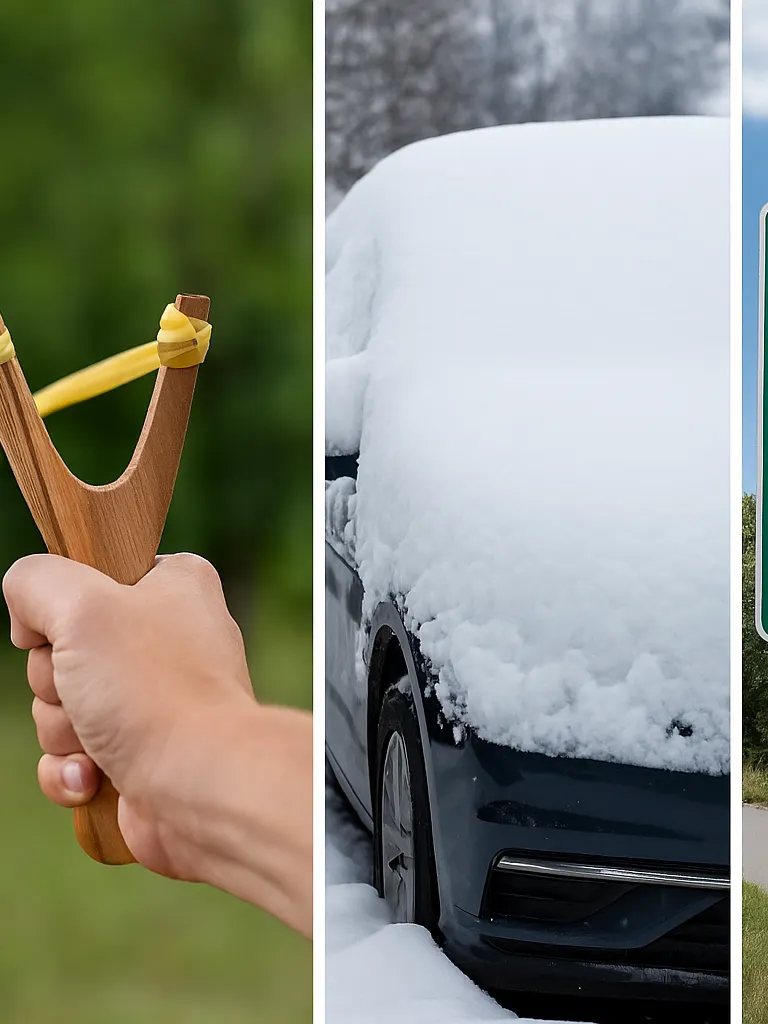
Winter driving in New Jersey often comes with winter hazards. Under the state law, drivers must remove snow and ice from their vehicles before hitting the road. If accumulated snow or ice flies off your moving car and causes injury or property damage, you can face significant fines — and even if nothing falls off, police can still ticket you for driving with dangerous buildup.
What drivers should do:
It’s one of the state’s more practical safety laws: unlike some of New Jersey’s weirder rules, this one isn’t unusual and rooted in safety instead of driving etiquette.
New Jersey’s weapons laws go far beyond firearms. Under the state’s prohibited weapons statute, even items that seem harmless elsewhere — like slingshots, gravity knives, or blackjacks — can land you in legal trouble if you possess them without a legitimate purpose.
Specifically, N.J.S.A. 2C:39-3(e) lists “slingshot” among several restricted items in the “certain weapons” category. Possession without an explainable lawful reason is treated as a fourth-degree crime, which can carry serious penalties.
While a backyard slingshot might be legal in most other states, this is one of those weird NJ laws that surprises many residents. If you're caught with a slingshot and can’t show a clear, lawful reason, such as sporting use or historical collection, you can expect serious scrutiny under New Jersey law.
Not feeding black bears might sound like one of those obvious and dumb laws in NJ that people joke about — but it is against the law for good reason. The rule is part of the state’s broader wildlife management and public safety policy, designed to keep both residents and animals safe.
Under New Jersey Department of Environmental Protection regulations, intentionally feeding bears is an enforceable offense that can lead to fines or other penalties. The goal is to prevent bears from associating humans with food — a behavior that often leads to dangerous encounters.
You shouldn’t feed the bears or leave food outside where they can easily reach it. Always secure your trash: it’s a smart safeguard for your safety and your neighborhood.
It’s one of those rules that surprises both visitors and lifelong residents — in New Jersey, you generally can’t let your vehicle idle for more than three minutes. The restriction is part of the state’s air-quality and anti-pollution program, enforced by the Department of Environmental Protection (DEP) and local authorities.
There are a few narrow exceptions, such as during extreme cold, while using a sleeper berth in heavy-duty diesel trucks, or in certain maintenance situations. But most drivers still should turn off their engines after a short wait.
How to stay compliant:
It may seem like a small thing, but reducing idling helps cut emissions, protect air quality, and avoid fines — making this one of New Jersey’s practical environmental laws rather than unusual ones.
It might seem harmless — a dealer-branded frame or a fun novelty border showing team pride — but in New Jersey, the wrong license plate frame can legally get you stopped by police.
In a 2021 ruling, the New Jersey Supreme Court made the standard clear: an officer may initiate a traffic stop if the frame conceals or obscures any part of the plate so that required information — such as “New Jersey,” “Garden State,” or the registration number — is not reasonably identifiable. However, if only a small portion of the border is covered and the wording remains clearly visible, that alone isn’t enough to justify a stop.
How to avoid trouble:
It’s one of those unusual but surprisingly strict New Jersey laws that catches many drivers off guard — yet keeping your license plate fully visible can spare you from an unnecessary traffic stop and a potential fine.
New Jersey remains one of the few states where BYOB — Bring Your Own Bottle — is still permitted, though with clear restrictions. Under state law, restaurants without liquor licenses may allow patrons to bring their own beer or wine, provided local ordinances do not prohibit it.
However, spirits and hard liquor are not allowed, and establishments may not charge a corkage or service fee for opening or serving your bottle.
Among the many weird laws in New Jersey, the state’s 2017 drone law stands out for how specific and serious it is.
Under this law, it’s a disorderly persons offense to operate a drone while intoxicated, interfere with emergency responders, or fly in a manner that endangers public safety. The statute also acknowledges federal preemption — meaning that federal aviation laws still take priority — but it empowers the state to act when unsafe or reckless operation occurs.
Important reminders:
New Jersey’s drone law reinforces a simple rule: know both the state and federal playbooks before you fly.
Since 2019, the state has banned smoking and vaping on public beaches and in state, county, and municipal parks. The measure expanded the New Jersey Smoke-Free Air Act to outdoor recreation areas, and today, most state parks post clear reminders that your personal vehicle is the only designated smoking area while on park property.
The rule helps cut down on cigarette litter, reduce fire risks, and protect families and children from secondhand smoke in shared outdoor spaces.
Plan ahead:
Of all the so-called dumb laws in New Jersey, this one is rooted firmly in public health and safety, and reflects the state’s push toward cleaner, safer public spaces.
As of May 4, 2022, New Jersey prohibits single-use plastic carryout bags at all retail stores and polystyrene foam food service products statewide; large grocery stores also cannot provide single-use paper bags. Plastic straws are available by request only.
What that means at checkout:
The ban serves a clear environmental purpose: cutting down on litter, protecting waterways, and reducing the state’s plastic waste footprint. It might take a little adjustment, but for many New Jerseyans, reusable bags have quickly become part of everyday life.
In New Jersey, raw unpasteurized milk cannot be sold directly to consumers — a restriction that sets the state apart from many others. Under current law, all milk offered for retail sale must be pasteurized, and while lawmakers have occasionally introduced bills to allow limited raw milk sales under strict permits, none have passed. For now, retail sales of raw milk remain strictly prohibited.
This unusual New Jersey law reflects the state’s cautious approach to consumer protection — prioritizing safety over nostalgia for “farm-fresh” products.
Pasteurization helps prevent serious illnesses. So if you ever see raw milk being sold within the state, it’s a sign that the seller is operating outside the law.
Under N.J.S.A. 2C:39-3(k), possessing handcuffs in “circumstances not manifestly appropriate” for lawful use can constitute a disorderly persons offense — meaning the cuffs can be confiscated and charges may follow.
This provision is one of New Jersey’s more weird but enforceable laws, aimed at preventing misuse of restraint devices outside of legitimate contexts such as law enforcement, security work, or training.
For security professionals, collectors, or hobbyists, understanding the “circumstances” standard is essential. Carrying handcuffs without a clear, appropriate reason could expose you to criminal liability under New Jersey law.
Many of New Jersey’s unusual laws trace back to practical roots that reflect the state’s unique conditions: high population, heavy traffic, and a long-standing focus on public safety and environmental protection.
Individually, each law can feel niche — the kind of regulations that earn the label “weird” or “dumb” laws in New Jersey. Yet together, they’re a portrait of how the Garden State tries to manage risk in close quarters — the tradeoff of living, driving and relaxing near your neighbors.
While some of those laws may sound strange at first, they are fully enforceable. In a densely populated state, even minor risks can escalate quickly, which is why these measures exist in the first place.
Knowing the law before you encounter it is always easier than learning about it after getting into legal trouble.
Sometimes these oddball rules collide with the workplace. Maybe a delivery driver was disciplined for violating the anti-idling rule, a retail employee in Bergen County keeps getting scheduled improperly on Sundays under local blue-law constraints, or a rideshare driver was cited under the snow-and-ice statute and worries about job security.
If a New Jersey employment situation lands you in a gray area — from discipline and discharge to wage deductions tied to tickets or scheduling — our team can walk you through your rights and options.
Contact us for legal advice and a free consultation.
We’re here to help New Jersey workers understand the law, assert their rights, and resolve issues early — before an unusual NJ law becomes a workplace problem.
 Denis Sautin
Stop wondering about your rights or if you'll be taken seriously. We treat every client with respect, urgency, and honesty. Our lawyers will listen, explain your legal options, and fight for the outcome you deserve.