
Jul 6, 2026


Airline and aviation employees in New Jersey operate under a unique mix of federal regulations, labor law, and industry safety rules. Flight crews, pilots, cabin staff, baggage handlers, maintenance workers, and ground operations staff are subject to different standards than workers in other industries. These rules shape scheduling, pay, safety requirements, how disputes are handled, and broader workplace rights.
Aviation employment rules produce different legal outcomes for flight crews and ground staff compared to standard workplace protections. Our legal team at Brandon J. Broderick regularly reviews cases where these specific standards influence issues such as wages, scheduling, fatigue limits, disciplinary actions, and termination. While many workers expect general labor law to control these situations, airline operations rely on a combination of regulatory compliance and internal employer policies.
This article explains how employment rules apply to airline and aviation workers, what protections exist for flight crews and ground staff, how federal regulations interact with workplace rights, and when to reach out to an employment lawyer in New Jersey.
Airline and aviation workers in New Jersey do not all follow the same employment rules. The airport makes the work look connected. The law still separates workers by job, employer, union status, worksite, and type of dispute.
A pilot, flight attendant, baggage handler, aircraft mechanic, cargo worker, gate agent, cabin cleaner, deicing worker, and catering employee all help keep flights moving. Their rights do not always come from the same statute.
Newark Liberty International Airport gives this issue real scale. The Port Authority reported 47 million passengers at Newark Liberty in 2025, making it the airport’s third-busiest year. The traffic depends on workers behind ticket counters and security checkpoints.
Federal law plays a larger role in aviation than it does in many New Jersey workplaces. Direct airline employees work under the Railway Labor Act, even though the law’s name refers to railroads. For covered airline employees, union representation comes from the law and the collective bargaining agreement.
The National Mediation Board explains that the Railway Labor Act covers labor-management relations in the railroad and airline industries. It gives the NMB a central role in union representation and dispute processes.
Not every worker at an airport falls under the law. Many ground workers are employed by contractors and subcontractors rather than by the airline whose planes they service. In our work representing airline employees, we often see situations where workers wearing branded gear are paid by a separate staffing agency. The distinction affects organizing rights, wage claims, discipline, and agency jurisdiction.
A 2024 National Mediation Board decision involving Swissport workers at Newark Liberty shows why the employer analysis matters. Swissport argued its Newark operations belonged under the Railway Labor Act. The NMB found that Swissport was not a common carrier by air and that its EWR operations were not subject to the Act's jurisdiction.
“The decision to speak up is powerful. But knowing what happens after — and how to protect yourself — is just as critical.”
— Olivia Rhye
The Fair Labor Standards Act excludes certain employees covered by Title II of the Railway Labor Act from federal overtime rules. New Jersey still applies its own wage requirements for air carrier industry employees, including overtime at one and one-half times the regular rate for nonexempt hours over 40 in a week.
A limited rescheduled-time-off rule exists when requested by the employee and when specific conditions are met, but it does not operate as a blanket exemption from overtime. The computer professional exemption may also apply under federal law, depending on job duties and pay structure. The Port Authority’s amended minimum wage rules set a higher wage floor. The airport minimum wage schedule rose to $21.25 on Jan. 1, 2026.
New Jersey’s Healthy Terminals Act adds another layer for covered workers at Newark Liberty International Airport and the Newark Liberty International Airport Train Station. The law sets prevailing wage rates for certain workers. It ties the standards to federal Service Contract Act wage determinations. Health and welfare payments and paid leave obligations also matter.
NJDOL’s Swissport enforcement action shows these rules have force. In 2024, the department announced more than $2.2 million in back wages and liquidated damages for 811 Swissport workers at Newark Airport. Cited violations included incorrect prevailing wage and health benefit rates, and unpaid or late wages.
Aviation workers should keep pay stubs, schedules, assignment sheets, texts, app messages, badge records, shuttle records, and photos of posted wage notices. Our attorneys at Brandon J. Broderick use this type of evidence to build claims and identify the correct legal theory, since it determines the strength and direction of a case. These details determine the right legal path.

Flight crews work under rules built around safety, fatigue, scheduling, and medical fitness. Pilots and flight attendants work schedules that change with delays or reroutes. Many ordinary workplace policies don’t always apply the same way. Federal rest requirements, leave laws, contract language, and the reason for the absence can all affect the outcome.
FAA rest rules are central to flightcrew scheduling. For pilots and other flightcrew members covered by Part 117, federal regulations require at least 10 consecutive hours of rest before a reserve or flight duty period. This includes at least eight uninterrupted hours of sleep.
Flight attendants are covered by a different rule. Under 14 C.F.R. § 121.467, a flight attendant scheduled for a duty period of 14 hours or less must receive at least 10 consecutive hours of rest before the next duty period. This rest period cannot be reduced.
These rest requirements can become employment issues when an employee is disciplined for refusing an assignment believed to be unsafe or calling out because the required rest period was not provided. Labeling the issue as an attendance or reliability problem doesn’t eliminate potential legal protections. How similar situations were handled provides important context.
Medical leave works differently for airline flight crews because the Family and Medical Leave Act recognizes that they do not work traditional hourly schedules.
The U.S. Department of Labor uses a different eligibility test for flight crew employees. They qualify by working or being paid for at least 60% of the applicable monthly guarantee and completing at least 504 duty hours during the previous 12 months. Eligible flight crew employees may take up to 72 days of FMLA leave for most qualifying reasons, or up to 156 days for military caregiver leave.
AIR21 protects aviation workers from retaliation for providing information related to air carrier safety.
Reports involving aircraft safety or regulatory compliance deserve careful review. That includes concerns about maintenance, fatigue, staffing, equipment, security, or other conditions that could affect safe operations. Common forms of retaliation include:
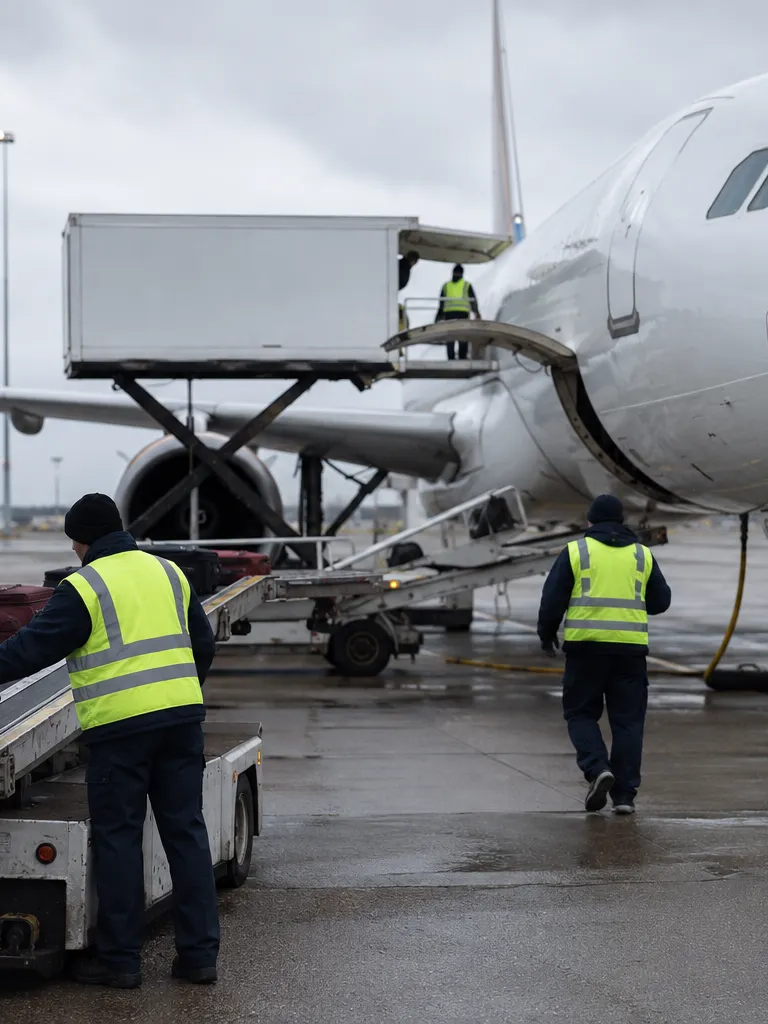
Ground staff labor rights deserve separate attention. These jobs involve contractors, physical risk, wage rules, and restricted-area access. For example, passenger service agents and mechanics work under heavy time pressure, but that doesn’t remove basic labor protections.
The Healthy Terminals Act is one of the key New Jersey laws for covered Newark airport workers. NJDOL lists Newark Liberty International Airport and the Newark Liberty International Airport Train Station as covered sites. Coverage depends on the job duties and the location. Some food preparation and delivery workers connected to airline food and beverage service also fall within the law.
Airport ground work carries a higher risk of injury. OSHA’s baggage handling guidance notes that ticket agents and ramp agents handle baggage at multiple points. Lifting, lowering, pushing, pulling, and awkward body positions all contribute to ergonomic hazards. This can contribute to cumulative trauma injuries when repeated stress builds up rather than coming from a single accident.
New Jersey workers’ compensation covers job-related injuries and illnesses with medical treatment and permanent disability compensation. For aviation workers, this includes:
Many aviation workers need restricted-area badges to perform their jobs. Federal airport security rules require identification systems and criminal history checks. When badge issues affect a worker's employment, employers must still comply with retaliation and bias laws.
Ground staff are covered by New Jersey's earned sick leave law. Employees accrue one hour of paid sick leave for every 30 hours worked, up to 40 hours during a benefit year, unless the employer chooses to provide all 40 hours at the start of the year. Employees who use protected sick leave because of illness or to care for a family member should not face retaliation.
Flight crews and ground staff work under employment rules that differ from those in most industries. Contact us today for a free consultation if you believe your rights were affected.
 Svetlana Skvortsova
Stop wondering about your rights or if you'll be taken seriously. We treat every client with respect, urgency, and honesty. Our lawyers will listen, explain your legal options, and fight for the outcome you deserve.